Do You Have Any Of These Violations On YOUR Mortgage?*
Below you will find some of the results we have found after auditing our client’s mortgages:
Audited Results:
* Excessive fee charged to borrower $ 11,042.12
* Over compensation to mortgage broker $22,379.86
* Wrong lender foreclosing on borrower
* Borrower never received acceleration notice
* No HUD given to borrower at closing
* Mortgage broker over stated borrower’s income by $225,000.00
* Mortgage broker added false bank account to borrower’s loan application for $66,000
* Asset based lending
* Bait and switch. Borrower was switched at closing into an ARM loan
* No pre-closing documents – TIL, GFE, IOAF, Loan type, Broker’s fees
* Margin 7.125% (Adjustable rate loans only)
* TIL and Note payments do not match
* TIL does not clearly state mortgage payment
* Loan discount $ 9,315.00 – No benefit to borrower
* Mortgage broker never disclosed their additional fee of $4,627.00
* Mortgage broker promised borrower a cash out of $76,000 if they closed the loan.
* Borrower received no note at the closing
* Borrower never signed any closing documents. Broker “lifted” borrower’s signatures from a
previous loan.
* Mortgage broker closed loan at borrower’s place of business without an attorney, notary or
title company.
* Foreclosure filed during the 30 notice period
* Loan flipping. No benefit to borrower
* Closing costs ($75,966.65) higher than GFE ($47,377.15)
* $28,589.50 missing from closing (HUD)
* Hidden payment to mortgage by bank (YSP $17,402.16)
* Mortgage broker over stated borrower’s bank account by $80,400.00
* Borrower was charged for the presence of an attorney when no one presented them
* High cost loan
* APR higher
* Borrower never received cash out as shown on HUD
* Borrower received no documents at closing
* Dual tracking -
* Borrower never served foreclosure documents
* Foreclosure illegally started
* Bank took payments from borrower and than foreclosed
* Process server falsified documents stating they served borrower when they did not.
* No pre-foreclosure documents given to borrower
* Foreclosure filed during the 30 day and 90 period.
* Real Estate broker, mortgage broker and attorney worked together to obtain financing and
sell property to an unsuspecting borrower providing him with false and misleading information
while also giving inaccurate and deceptive information to the lender.
* The results shown above are the results from auditing the loans of both former and current clients. No guarantees can be offered or made as to the types, amounts or severity of violations that may be found on future audits.
CALL TODAY FOR A FREE CONSULTATION
Law Offices of Robert E. Brown, P.C
2409 Richmond Road, Staten Island, N.Y. 10306
Phone: 718-979-9779

An informational blog pertaining to foreclosure law and foreclosure defense practice.
© Copyright 2015 Law Offices of Robert E. Brown, P.C. All Rights Reserved.
Friday, November 4, 2011


Thursday, November 3, 2011
Fannie Mae, Freddie Mac executives get big housing bonuses
The Obama administration’s efforts to fix the housing crisis may have fallen well short of helping millions of distressed mortgage holders, but they have led to seven-figure paydays for some top executives at troubled mortgage giants Fannie Mae and Freddie Mac.
The Federal Housing Finance Agency, the government regulator for Fannie and Freddie, approved $12.79 million in bonus pay after 10 executives from the two government-sponsored corporations last year met modest performance targets tied to modifying mortgages in jeopardy of foreclosure.
The executives got the bonuses about two years after the federally backed mortgage giants received nearly $170 billion in taxpayer bailouts — and despite pledges by FHFA, the office tasked with keeping them solvent, that it would adjust the level of CEO-level pay after critics slammed huge compensation packages paid out to former Fannie Mae CEO Franklin Raines and others.
Securities and Exchange Commission documents show that Ed Haldeman, who announced last week that he is stepping down as Freddie Mac’s CEO, received a base salary of $900,000 last year yet took home an additional $2.3 million in bonus pay. Records show other Fannie and Freddie executives got similar Wall Street-style compensation packages; Fannie Mae CEO Michael Williams, for example, got $2.37 million in performance bonuses.
Including Haldeman, the top five officers at Freddie banked a combined $6.46 million in performance pay alone last year, though a second bonus installment for 2010 has yet to be reported to the SEC, according to agency records. Williams and others at Fannie pocketed $6.33 million in incentives for what SEC records describe as meeting the primary goal of providing “liquidity, stability and affordability” to the national market.
“Freddie Mac has done a considerable amount on behalf of the American taxpayers to support the housing finance market since entering into conservatorship,” Freddie spokesman Michael Cosgrove, told POLITICO on Monday. “We’re providing mortgage funding and continuous liquidity to the market. Together with Fannie Mae, we’ve funded the large majority of the nation’s residential loans. We’re insisting on responsible lending.”
A Fannie Mae spokesman said it is currently in a “quiet period” in advance of its third-quarter earnings report and declined to comment.
Most analysts believe the financial implosion of 2008 was fueled in part by Fannie Mae and Freddie Mac’s zeal in promoting homeownership and their backing of risky loans. And critics say that the mortgage giants’ deep backlog of repossessed homes, and their struggle through government conservatorship, is a staggering weight on a weak economy and puts even more downward pressure on home values.
“Fannie and Freddie executives are being paid millions to manage losses,” Rep. Patrick McHenry (R-N.C.), a longtime critic of the administration’s programs to rescue the housing market, told POLITICO. “By these same standards, I should be the starting forward for the Lakers. It’s completely absurd.”
“It is outrageous that senior executives at Fannie and Freddie are receiving multimillion-dollar compensation packages when they now rely on funding from U.S. taxpayers, many of whom face foreclosure or whose homes are underwater,” Rep. Elijah Cummings of Maryland, who has led House Democrats in efforts to ease Fannie and Freddie’s restrictions on restructuring loans or lowering payments for mortgage holders who owe more than their homes are worth, wrote in an email.
Compensation at Fannie and Freddie is, in fact, 40 percent below pre-government takeover levels, according to the FHFA, though those pay packages before conservatorship involved stock awards, while the current payments are exclusively cash. But compensation at both corporations, in particular Fannie Mae, has been a contentious issue since long before the 2008 financial meltdown, thanks to executives like Daniel Mudd, who earned $12.2 million in base pay and bonuses while heading Fannie, and Richard Syron, Freddie’s CEO, who pocketed $19.8 million in total compensation the year before the organization went into conservatorship.
- «Both Fannie and Freddie have long argued that they have to offer Wall Street-size paychecks to compete for the best private-sector talent. House Financial Services Committee Chairman Spencer Bachus (R-Ala.) introduced a bill in April to place the executives on a government pay scale, but it has yet to move out of committee.
FHFA’s acting director, Edward J. DeMarco, told Congress last year that the managers who were at the helms of the mortgage companies during the market collapse were dismissed but also argued that generous pay helps lure “experienced, qualified” executives able to manage upward of $5 trillion in mortgage holdings amid market turmoil.
DeMarco told lawmakers he’s concerned that suggestions to apply “a federal pay system to nonfederal employees” could put the companies in jeopardy of mismanagement and result in another taxpayer bailout. He said the compensation packages at Fannie and Freddie are part of the plan to return them to solvency while reducing costs to taxpayers.
A March report by FHFA’s inspector general, however, found the agency “lacks key controls necessary to monitor” executive compensation, nor has it developed written procedures for evaluating those packages.
An FHFA representative said the agency is installing pay package recommendations outlined in the report. Currently, she wrote, the agency “carefully reviews all executive officer pay requests and considers suitability and comparability with market practice, after consulting with the Treasury Department in certain circumstances.”
Since both companies’ stock is worthless, bonuses are paid in cash, deferred bonuses and incentive pay rather than stock options. A key factor in determining those bonuses is how Fannie and Freddie performed in the loan modification program created by the administration, in addition to measures tied to financial and accounting objectives.
For example, Freddie Mac helped a mere 160,000 homeowners change their mortgages “in support” of the president’s Home Affordable Modification Programand contacted only 45 percent of eligible borrowers, according to SEC filings. The company itself has modified 134,282 of its own loans since the start of the program. Those measures determined a significant share — 35 percent — of deferred bonus salary and, to a lesser extent, “target incentives” for Freddie executives.
Fannie, which was involved in modifying 400,000 mortgages last year, also assessed executive payments based in part on how it administered HAMP.
President Barack Obama in the past has derided Wall Street “fat cats” for raking in seven-figure bonuses even though their banks and finance companies needed billions of dollars in government bailouts just to stay in business. Yet the White House so far has remained largely silent about comparable bonuses at Fannie Mae and Freddie Mac.
The congressional criticism over compensation follows other charges that DeMarco has been unwilling to throw a lifeline to homeowners plunged underwater when the market collapsed.
The government-sponsored firms have essentially filled the vacuum caused by an exodus from private lenders. But critics want the FHFA to embrace “principal write-downs,” in which lenders and, by extension, Fannie and Freddie, would have to forgive a significant portion of homeowners’ outstanding mortgages; the move, they argue, would be a major step toward restoring housing market stability and boosting the economy but would force the two companies to accept red ink on their balance sheets.
DeMarco has resisted plans to modify troubled mortgages, insisting it wasn’t part of his legal mandate to bring Fannie and Freddie to fiscal stability.
Both HAMP and a similar program, Home Affordable Refinance Program, were seen as having the potential to modify at least 3 million government-backed mortgages and refinance 4 million others. The results were disappointing, however: Just 1.7 million borrowers have been helped since the programs were launched two years ago.
Last week, the White House announced a plan to relax restrictions for the HARP refinance program, which lets homeowners in good standing refinance their mortgages at current rock-bottom interest rates. DeMarco, whom aides say had been studying a similar proposal, gave the plan his blessing — a rare point of agreement between him and the Obama administration.
CORRECTION: An earlier version of this story incorrectly described the process by which the federal government took over Fannie Mae and Freddie Mac. They were both placed in conservatorship under the supervision of the Federal Housing Finance Agency.
“Worst Person of the Week” | Keith Olbermann Wears Guy Fawkes Mask While Giving Out Steven J. Baum’s Address (MUST VIEW VIDEO)
Be sure to watch the entire video…
“Steven J. Baum of Buffalo, NY is the state’s largest foreclosure mill,”
“It represents banks and mortgage servicers in their efforts to foreclose on homeowners and throw them out. It has been accused of trickery to try to evict people with steady incomes who were up to date on their mortgages. So naturally for Halloween, Steven J. Baum encouraged its employees — all of whom, I assume live in terror of becoming the next victims of their scumbag bosses — to dress up for homeless people, carrying bottles of booze, wearing signs that mock the excuse of those that have been unfairly evicted.”
Olbermann asked as the camera revealed him a Guy Fawkes mask.
“So this is what they dress up as for Halloween? We’re going to play that game, are we?”
Fawkes is a historical figure that has been adopted as a symbol of the hacker activist group “Anonymous.” The mask has recently been a favorite of protesters across the world.
And just like Anonymous might do, Olbermann disclosed the physical addresses of Steven J. Baum offices in Amherst and Long Island.
“It’s a long game, Steven J. Baum, and there are many costumes to be worn,”
“Being a foreclosure mill law firm is bad enough, adding visual abuse of your victims on Halloween, poor choice.”
Bank of America Forecloses on Home that does NOT Exist
The Law Offices of Robert E. Brown, P.C.

Bank Forecloses On Home Destroyed By Ike
HOUSTON — Hurricane Ike destroyed dozens of homes in Seabrook. Many families are just now rebuilding, but when Brad Gana tried to pick up the pieces, he learned that Bank of America was trying to take what little he had left.”
I was shocked when they said they were foreclosing on it,” Gana told investigator Amy Davis.
Gana was working overseas when the hurricane hit, destroying his home. But even then, he said he never missed a mortgage payment. It took him days to figure out why Bank of America was foreclosing.
“It wasn’t until about 20 calls that someone said, ‘We had a homeowner’s policy on your home that you reside in, and your monthly payments have gone up,’” Gana explained. “But they never notified me that my monthly payments had gone up.
“That’s right. Bank of America took out a forced homeowner’s policy on an empty slab.
You can check out the rest with video here…
United States of America v Allied Home Mortgage | Feds File Massive Fraud Case Against Allied Home Mortgage
The Law Offices of Robert E. Brown, P.C.
United States of America v Allied Home Mortgage | Feds File Massive Fraud Case Against Allied Home Mortgage

Feds File Massive Fraud Case Against Allied Home Mortgage
by Tracy Weber and Charles Ornstein ProPublica,
Federal prosecutors sued Allied Home Mortgage Capital Corp. and two top executives Tuesday, accusing them of running a massive fraud scheme that cost the government at least $834 million in insurance claims on defaulted home loans.
Houston-based Allied and its founder and chief executive, Jim Hodge, were the subject of July 2010 stories by ProPublica [1], which detailed a trail of alleged misconduct, lawsuits and government sanctions spanning at least 18 states [2] and seven years. Borrowers recounted how they had been lied to by Allied employees, who in some cases had siphoned their loan proceeds for personal gain. Some lost their homes.
Despite years of warnings, the federal government had not — until this week — impaired the company’s ability to issue new mortgages.
The suit [3], filed Tuesday in U.S. District Court in Manhattan, seeks triple damages and civil penalties, which could total $2.5 billion. Simultaneously, the U.S. Department of Housing and Urban Development suspended the company and Hodge from issuing loans [4] backed by the Federal Housing Administration. The company was also barred from issuing mortgage-backed securities through the Government National Mortgage Association (Ginnie Mae).
Allied has billed itself as the nation’s largest privately held mortgage broker with some 200 branches. (At one point, the company operated more than 600.) The sprawling network made Hodge, a folksy Texan, a rich man [5] with properties in three states and St. Croix and two airplanes to get to them.
Allied and Hodge played the “lending industry equivalent of heads-I-win and tails-you-lose,” U.S. Attorney Preet Bharara said at a news conference Tuesday. “The losers here were American taxpayers and the thousands of families who faced foreclosure because they could not ultimately fulfill their obligations on mortgages that were doomed to fail.”
The government’s complaint alleges that between 2001 and 2010, Allied originated 112,324 home mortgages backed by the FHA, which typically go to moderate- and low-income borrowers. Of those, nearly 32 percent — 35,801 — defaulted, resulting in more than $834 million in insurance claims paid by HUD.
In 2006 and 2007, the company’s default rate was a “staggering” 55 percent, the complaint said.
In addition, another 2,509 mortgages are currently in default, which could result in another $363 million in insurance claims paid by HUD.
Borrowers told ProPublica last year that company employees falsified records to bolster their credit worthiness and lured them into unaffordable deals by lying about the terms.
The government’s complaint says: “Allied has profited for years as one of the nation’s largest FHA lenders by engaging in reckless mortgage lending, flouting the requirements of the FHA mortgage insurance program and repeatedly lying about its compliance.”
Tuesday’s action against Allied follows criticism that the government has been slow to act on rampant fraud and abuse in the mortgage market. In the case of Allied, the government had reams of evidence of possible misconduct. Among ProPublica’s findings last year:
- Allied had the highest serious delinquency rate [6] among the top 20 FHA loan originators from June 2008 through May 2010.
- Nine states sanctioned the firm from 2009 to mid-2010 for such violations as using unlicensed brokers and misleading a borrower.
- Federal agencies cited or settled with Allied or an affiliate at least six times since 2003 for overcharging clients, underpaying workers or other offenses.
- At least five lenders sued, claiming Allied tricked them into funding loans for unqualified buyers by falsifying documents and submitting grossly inflated appraisals, among other allegations.
Allied spokesman Joe James said the company was aware of the government lawsuit but had not received a copy of it and could not comment.
Hodge did not return a phone call and email seeking comment. But last year, he told ProPublica that the problems experienced at some of Allied’s branches should not tarnish his firm’s overall record. “If you look at the volume that we did or do,” he said, “it’s not significant.”
In an interview Tuesday, Helen Kanovsky, HUD’s general counsel, defended the time it took her department to take action.
“We had tried sanctions before,” she said. “We had assessed civil monetary penalties and that had not worked.
“The extraordinary remedy that we have — to be able to terminate somebody’s FHA capacity [and] basically put them out of business — requires a very high level of evidence and a high level of proof.”
The government’s 41-page lawsuit details an alleged scheme by Allied to deceive HUD about its employees and the risks associated with its loans. For years, it operated a network of “shadow” branches that were not approved by HUD and falsely certified that they met legal requirements.
Allied also disguised the high default rates of some branches, the complaint alleges, by tinkering with their addresses to apply for new HUD identification codes for the same offices. When HUD updated its system to prevent such manipulation, Allied simply moved all of its branches to a sister company and obtained new IDs, “thus again achieving a clean slate on its default rates,” the suit said. The sister firm, Allied Home Mortgage Corp., is also named as a defendant.
Hodge created a “culture of corruption,” the suit said. He “intimidated employees by spontaneous terminations and aggressive email monitoring, and silenced former employees by actual and threatened litigation against them.”
In one case, Hodge instructed his chief information officer to capture the password for the personal email account of Jeanne Stell, the company’s executive vice president and compliance officer. Then, he installed an electronic listening device under the information officer’s desk, the complaint alleges.
Allied also was employing felons, including a state manager who had been sentenced to 60 months in prison for distributing methamphetamine and a branch manager running the office under a falsely-assumed name, the suit said.
The government joined a whistleblower lawsuit filed by a former Allied branch manager in Massachusetts, Peter Belli. In addition to Allied and Hodge, the suit also names Stell as a defendant.
Belli had filed other suits against Hodge and Allied. He said Tuesday that, while his legal pursuit of his former employer had been long and hard, “I never really ever felt like quitting because I was married to the cause.”
Allied is also facing at least one federal criminal investigation into its now-shuttered Hammond, La., branch. In multiple lawsuits, borrowers allege that the office deceived them from 2005 through 2007 by misrepresenting loan terms, falsifying records, failing to pay off prior mortgages and diverting hundreds of thousands of dollars.
At his news conference, Bharara said Tuesday’s filing was a civil matter and that the investigation into Allied is continuing. “We will go wherever the facts lead us.”
Why the SEC Won't Hunt Big Dogs
"I was going to make a comment, but I think this one comment (in part) says everything" - John Brancato, Loss Mitigation Robert E. Brown, P.C. "I worked at the SEC HQ. I will tell you why this is all going on, because the SEC is the biggest revolving door for Government Attorneys. They work in Enforcement or Litigation for a few years and then rotate into a Securities firm doing Defense."
Note: The Trade is not subject to our Creative Commons license.
Back when the Financial Crisis Inquiry Commission [1] was doing its work, I would check in periodically with someone who worked there to find out how it was going.
"Good news!" my source would joke. "We got the guy who caused it."
In addition, the S.E.C. accused one person -- a low-level banker. Hooray, we finally got the guy who caused the financial crisis! The Occupy Wall Street protestors can now go home.
After years of lengthy investigations into collateralized debt obligations, the mortgage securities at the heart of the financial crisis, the S.E.C. has brought civil actions against only two small-time bankers. But compared with the Justice Department, the S.E.C. is the second coming of Eliot Ness. No major investment banker has been brought up on criminal charges stemming from the financial crisis.
To understand why that is so pathetic and -- worse -- corrupting, we need to briefly review what went on in C.D.O.'s in the years before the crisis. By 2006, legions of Wall Street bankers had turned C.D.O.'s into vehicles for their own personal enrichment, at the expense of their customers.
These bankers brought in savvy (and cynical) investors to buy pieces of the deals that they could not sell. These investors bet against the deals. Worse, they skewed the deals by exercising influence over what securities went into the C.D.O.'s, and they pushed for the worst possible stuff to be included.
The investment banks did not disclose any of this to the investors on the other side of the deals, or if they did, they slipped a vague, legalistic disclosure sentence into the middle of hundreds of pages of dense documentation. In the case brought last week, Citigroup was selling the deal, called Class V Funding III, while its own traders were filling it up with garbage and betting against it.
By the S.E.C.'s own investigations of and settlements with Goldman Sachs [3], JPMorgan Chase [4] and Citigroup, and by reporting like my ProPublica work with Jake Bernstein [5] and early [6] stories [7] by The Wall Street Journal, we know that these breaches were anything but isolated. This was the Wall Street business model. (Goldman, JPMorgan and Citigroup were all able to settle without admitting or denying anything, which, of course, is part of the problem.)
Neither the Citigroup settlement nor any of the others come close to matching the profits and bonuses that these banks generated in making these deals. And low-level bankers did not, and could not, act alone. They were not rogues, hiding things from their bosses.
Last week's S.E.C. complaint makes clear [8] that the low-level Citigroup banker that it sued, Brian H. Stoker, had multiple conversations with his superiors about the details of Class V. At one point, Mr. Stoker's boss pressed him to make sure that their group got "credit" for the profits on the short that was made by another group at the bank.
Pause, and think about that. The boss was looking for credit, but as far as the S.E.C. was concerned, he got no blame.
The S.E.C. did not respond to a request for comment, so we are left to wonder what explains its failure to reckon adequately with the pervasive problems. Contrary to expectations, the embattled and oft-assailed agency has done almost everything right with structured finance investigations, taking aim at abuses related to C.D.O.'s and other complex deals.
The S.E.C. has also devoted adequate resources to the issue. It put together a special task force on structured finance, sending the proper signal of the agency's priorities both internally and externally. The task force is staffed by bright people, an invigorating mix of young go-getters and experienced hands. Those people have understood for years what was wrong with the C.D.O. business on Wall Street.
O.K., so what is it? Risk aversion.
Based on the major cases the S.E.C. has brought, a pattern has emerged. It is making one settlement per firm and concentrating on only the safest, most airtight cases. The agency's yardstick seems to be, who wrote the stupidest e-mail? Mr. Stoker of Citigroup wrote an incriminating e-mail that recommended keeping one crucial participant in the dark. Goldman's Fabrice Tourre, the other functionary the agency has sued, wrote dumb things to his girlfriend.
But the S.E.C is not the G-mail G-man. It is the securities police. Imprudent e-mailing is not the only way to commit securities fraud.
Maybe the agency hopes that private litigation will take up the slack. It cannot investigate and wring a prosecution or settlement out of every corrupt deal. Instead, it has long aimed to plant a flag and let private litigants take care of the rest.
But private litigation has failed. One problem is that the defrauded institutions often committed their own sins. In a monstrous daisy chain, C.D.O.'s bought pieces of other C.D.O.'s. These investments were run by management companies. They might have been the victim in one C.D.O., but complicit in the predations of another.
Other victims, like large financial institutions and money managers, do not want to sue because it could reveal their own compromised behavior. Or they would be revealing to customers that they had simply been taken by other, smarter bankers. You cannot very well convince people that you are a good steward of their money if you are simultaneously complaining that the Wall Street sharpies fleeced you.
And private litigation has changed in the last decade and a half. The Private Securities Litigation Reform Act of 1995, which was meant to make class-action lawsuits harder to bring, has had a spillover effect beyond those cases, according to plaintiffs' lawyers. Courts have raised the bar for securities fraud cases, even where the act does not apply. The rules color how judges look at financial disputes.
So the S.E.C. has the wrong approach.
This is a matter of will and leadership. Its chairwoman, Mary L. Schapiro, while deserving credit for pushing investigations of structured investments, is sending the signal that she does not want to lose. Her agency is meekly willing to get token settlements when the situation calls for Old Testament justice.
Someday, the S.E.C. will have to go up against a top executive who has resources to fight, and who was too sophisticated to put anything rash in writing. This seems to be our fate: our bankers took reckless risks, but our regulators take none.
Ally Takes Exception to Settlement Proposal
The Law Offices of Robert E. Brown, P.C.
Ally Financial’s CEO Michael Carpenter told investors Wednesday that his company “would not settle for the kind of numbers being bandied about” as recompense for mishandled foreclosure paperwork.

Ally’s GMAC Mortgage was the first servicer to admit to robo-signing issues and affidavit errors related to foreclosure processing last fall, and it’s one of five major servicers in talks with state attorneys general to settle such infractions.
Earlier this week, details of the multi-state settlement proposal currently on the table surfaced, carrying a price tag of $25 billion to be levied collectively against Ally, Bank of America, Citigroup, JPMorgan Chase, and Wells Fargo.
As the settlement terms stand now, servicer penalties would be based on the number of foreclosures each company has completed. Of the total $25 billion settle-
ment amount, $5 billion would come in the form of cash payment penalties. The remaining $20 billion would take shape in principal-reducing modifications and refinancing for underwater borrowers.
Analysts estimate Ally could be on the hook for $2.5 billion — $500 million in cash and $2 billion in refis and mods.
On the company’s third-quarter earnings call Wednesday, Carpenter said Ally’s liability should be a “small fraction” of that.
He said while Ally “regretted sloppy operational practices,” the company found no instances in which borrowers were wrongfully foreclosed on after conducting its own extensive audits of past cases.
Ally posted a deficit for the third quarter, attributable to a $471 pre-tax loss related to its mortgage servicing rights (MSR), which lost value as a result of the decline in interest rates and market volatility, the Detroit-based company explained.
Ally says it plans to take immediate action to reduce its focus on the correspondent mortgage channel.
“As the mortgage industry changes, the model for mortgage businesses will also change, and we believe a fee-based structure would enable less risk and a greater ability to serve customers,” Carpenter said of the MSR impact on the company’s overall financials.
Ally reported a net loss of $210 million for the third quarter of 2011, compared to net income of $113 million in the prior quarter and net income of $269 million for the third quarter of 2010.
Congress Calls for Transparency in Foreclosure Reviews
The Law Offices of Robert E. Brown
As several large servicers begin the lengthy process of an independent foreclosure review, Rep. Maxine Waters (D-California) is repeating her request that the process be made public.

Waters addresses a few major concerns in her most recent leltter, including the difficulty of reaching some of the affected borrowers, conflicts of interests between the banks and the independent reviewers, and the qualifications of those contracted to audit foreclosure cases.
After receiving no response to her original request three months ago, Waters sent a second letter to acting Comptroller of the Currency John Walsh and Federal Reserve Chairman Ben Bernanke last week. Fifteen of her colleagues joined her in her request.
“With more than six months having passed since the release of the Consent Orders, and more than three months having passed since our initial request for transparency,
we fear that public confidence in this process is quickly eroding,” Waters writes.
Waters stresses that after foreclosure, it will be difficult to track down some borrowers, and thus far “[s]ervicers have a poor track-record in effectively engaging with borrowers.”
In addition, while the reviews are supposedly “independent,” some have raised concerns about conflicts of interest. An American Banker article earlier this month called attention to the fact that the consent orders allow banks to choose their own independent reviewers.
As such, banks are engaging with firms they have worked with on a regular basis – firms which rely on the banks for recurring auditing assignments, the article states.
Lastly, Waters cites job solicitations for “mortgage foreclosure file reviewers” that do not require legal expertise. “Distressingly, the job solicitations for these positions seem to suggest that servicers intend to hire individuals with no more expertise than the so-called ‘robo-signers’ that created many of these problems in the first place,” she states in the letter.
“The only way this claims process will be fair is if the regulators shine a bright light on mortgage servicers, and make them demonstrate to the public how they’re being held accountable,” Waters says. “To date, this entire exercise has been conducted in the shadows.”
“I fear that without greater transparency, we’re setting homeowners, and foreclosed-upon families, up for more disappointment,” Waters adds.
NY foreclosure firm: Sorry for mocking homeless
The Law Offices of Robert E. Brown, P.C.

By CAROLYN THOMPSON 
BUFFALO, N.Y. — The head of a foreclosure law firm whose employees mocked victims of the mortgage crisis at a Halloween party last year apologized Wednesday to an outraged advocate for the homeless who said the firm showed "a disgusting lack of sensitivity."
Pictures from the Steven J. Baum law firm's 2010 Halloween party turned up last week in The New York Times, which said it received them from an unidentified former employee.
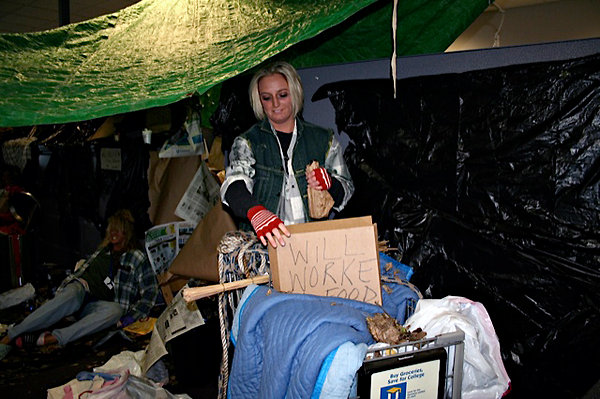
The pictures show people dressed to look homeless and a sign reading "Baum Estates" near part of the office decorated to resemble a row of foreclosed homes. Another picture features a tattered green tarp over what appears to be a hovel for the homeless.
The Baum law firm in suburban Buffalo is one of the largest-volume mortgage foreclosure firms in New York. Last year, it handled nearly 40 percent of the 46,572 foreclosure actions brought in New York courts, the New York Law Journal reported in February.
Amid an investigation by the U.S. attorney's office in Manhattan, Baum agreed last month to pay $2 million and change its practices after admitting to errors in legal filings that it blamed on the high volume of mortgage defaults and foreclosures it handles.
New York Attorney General Eric Schneiderman also is investigating the firm's practices, a person familiar with the investigation said, speaking on condition of anonymity because active investigations are not discussed publicly.
After denying to the Times that employees had mocked those who had lost their homes, the firm has in recent days acknowledged the costumes were inappropriate and apologized for last year's Halloween party.
The news comes as foreclosures continue to create a drag on the American economy and protests have erupted around the nation to protest what activists say is rampant corporate greed and influence on government that maintains a crippling disparity between rich and poor.
"I again want to sincerely apologize for the inappropriate costumes worn by some of our employees at our Halloween Party in 2010. It was in extremely poor taste and I take full responsibility," Steven J. Baum said in an emailed statement to The Associated Press on Wednesday. "I know people were extremely offended and people have every right to be upset with me and my firm."
Baum later met with Dale Zuchlewski, executive director of the Homeless Alliance of Western New York, who had sent a letter demanding an apology and offering to educate employees on the plight of the homeless.
"Your firm and its employees profit at the misfortunes of others and are an active participant in making people homeless in the first place," Zuchlewski wrote. "Allowing employees to participate in a company sponsored function such as this shows a disgusting lack of sensitivity. ... Mocking others is a former of bullying that simply cannot be tolerated in our society."
After the meeting, Zuchlewski said Baum reported that he didn't know about the party at one of the firm's offices, but that he took responsibility.
"He offered no excuses, apologized several times and has offered to have himself and his employees volunteer for homeless causes on a regular basis," Zuchlewski said.
By CAROLYN THOMPSON
Tuesday, November 1, 2011
Potential felony charges make servicers pause Nevada foreclosures
The Law Offices of Robert E. Brown, P.C.

Potential felony charges make servicers pause Nevada foreclosures
by JON PRIOR
Many mortgage servicers stopped initiating foreclosures in Nevada because of a new law, which carried threats of criminal penalties for faulty filings. Assembly Bill 284 took effect Oct. 1, making it a felony if a mortgage servicer or trustee made false representations concerning a title. There also will be a $5,000 fine assessed if fraud, such as robo-signing, is detected. The new law requires servicers to provide a new affidavit that provides the amount due on the mortgage, who is in possession of the note and who has the authority to foreclose.
Cathe Cole, vice president of default for Trustee Corps., a designated foreclosure counsel in Nevada for Freddie Mac, and representatives from the law firm Malcolm & Cisneros sat down with the Nevada Attorney General office to voice industry concerns.
"There was a model affidavit provided by attorney general," Cole said. "There was a senior deputy AG there and they were very adamant that there was never an intention for Nevada to be a judicial foreclosure state."
Cole said as long as servicers and trustees show a clear chain of title through to the name of the entity servicers are foreclosing in the name of, there would be nothing to fear. The AG office stressed to her what they are attempting to do is shut down unfair business practices, such as robo-signing, that surfaced last year and they're afraid are still going on.
"They stressed they were not on a witch hunt," Cole said. "They just want to make sure we're doing things correctly. If a homeowner brings a mistake to the court, there's even a 20-day period where we can correct it."
Cases cropped up all over the country during the foreclosure crisis, challenging banks to provide a clear chain of title. Many cases challenged the authority of Mortgage Electronic Registration Systems in foreclosures, a system designed by major lenders and the government-sponsored enterprises to track the chain of title. Cole said the Nevada law was not designed to take on MERS.
"They're intent is not to battle MERS. That's never been their intent. That's for some other court to decide," Cole said. "As long as the assignment chain is in line, that's all they're looking at."
According to RealtyTrac, Nevada has maintained the highest foreclosure rate every month for nearly six years as of August. Home prices in the state have been halved since their peak in 2007, and currently one in every 118 properties is in foreclosure.
Cole said the model affidavit she was provided could be a draft for the one her office is designing for clients. In the end, she said, the industry simply needs to take care of the fundamentals in order to move forward and restore the nonjudicial foreclosure process.
"They talked about mistakes. Never attest to something you don't know. If you're signing an affidavit, make sure you're attesting to what the items are," Cole said. "I'm confident we can move forward with nonjudicial foreclosures. Some are just waiting for what the uniform affidavits are."
Write to Jon Prior.
Follow him on Twitter @jonaprior.
ORDERED that the cross motion of defendants Malak Ghobrial and Stephanie Naveja-Ghavrial is granted to the extent that the complaint is dismissed
Another win for the Law Offices of Robert E. Brown!
Are you having problems with your lender? Denied a loan modification? In foreclosure? Have a predatory mortgage? Let Staten Island's most experienced foreclosure defense law firm protect you and your family against predatory banks.
Call today for a FREE NO OBLIGATION CONSULTATION.
Phone: 718-979-9779
Wells Fargo Bank, NA v Ghobrial
2011 NY Slip Op 51808(U)
Decided on October 11, 2011
Supreme Court, Richmond County
Aliotta, J.
Published by New York State Law Reporting Bureau pursuant to Judiciary Law § 431.
This opinion is uncorrected and will not be published in the printed Official Reports.Decided on October 11, 2011
Supreme Court, Richmond County
Wells Fargo Bank, NA, Plaintiff, againstMalak Ghobrial, STEPHANIE NAVEJA-GHAVRIAL, NEW YORK CITY ENVIRONMENTAL CONTROL BOARD, NEW YORK CITY TRANSIT ADJUDICATION BUREAU, WELLS FARGO BANK, NA, MARIAM GHOBRIAL, Defendants. 100867/08 Thomas P. Aliotta, J.
The following papers numbered 1-3 were marked fully submitted on the 18th day of August, 2011:
Pages
Numbered Notice of Motion for Execution of Judgment of Foreclosure and Sale by Plaintiff, with Supporting Papers and Exhibits (dated December 16, 2009).....................................................................................1 *While this motion was subsequently withdrawn, the supporting papers and affidavits were necessary for consideration of the disposition of the cross motion. Notice of Cross Motion to Dismiss by Defendants Malak Ghobrial and Stephanie Naveja-Ghavrial, with Supporting Papers and Exhibits (dated March 11, 2010)...........................................................................................2 Reply and Affirmation in Opposition to Cross Motion by Plaintiff with Supporting Papers and Exhibits (dated May 19, 2010)..............................................................................................3
Upon the foregoing papers, the motion to dismiss the complaint is granted.
This is an action to foreclose a mortgage in which plaintiff Wells Fargo Bank, NA (hereinafter "Wells Fargo" or "plaintiff") claims that defendants Malak Ghobrial and Stephanie Naveja-Ghavrial (hereinafter "defendants") are in default as a result of their having failed to make the required payments since November 1, 2007. To the extent relevant, the plaintiff lender commenced the instant foreclosure action on or about February 29, 2008 and an Order of Reference was granted thereafter. Defendants' pro se answer is dated April 29, 2008.
In an attempt at loss mitigation with the defendants, plaintiff withdrew its motion for a judgment of foreclosure and sale, and a settlement conference was subsequently scheduled for June 12, 2009. When the defendants failed to appear, plaintiff resubmitted its prior motion. However, [*2]that motion was again withdrawn on February 3, 2011.[FN1]
Defendants have since retained counsel and now move to dismiss the complaint pursuant to CPLR 3211(a) on the grounds, inter alia, that plaintiff (1) failed to elect its remedies in conformity with Real Property Actions and Proceedings Law (RPAPL) §1301; (2) failed to properly verify the Complaint; (3) lacks the capacity to stand in the shoes of Wells Fargo as a named defendant and subordinate mortgagee; (4) failed to provide the requisite acceleration notice as a condition precedent to foreclosure as provided in the mortgage contract; and (5) as a foreign corporation, is not authorized to do business in the State of New York. In addition, defendants now maintain that plaintiff lacks standing to sue.
Having failed to interpose an answer asserting plaintiff's alleged lack of standing, or to file a timely pre-answer motion to dismiss on this basis, defendants have waived their right to object thereto (see CPLR 3211[e]; US Bank Natl Assn v. Eaddy, 79 AD3d 1022 [2nd Dept 2010]; cf. Countrywide Home Loans Servicing, LP v. Albert, 78 AD3d 983 [2nd Dept 2010]). Nevertheless, it appears that the objection is without merit, as plaintiff has proved its standing as both the holder of the subject mortgage and note at the time the action was commenced (see US Bank NA v. Madero, 80 AD3d 751 [2nd Dept 2011]).
In support of dismissal, defendants also assert that the complaint impermissibly seeks foreclosure, while simultaneously demanding judgment on the underlying note. This is alleged to violate RPAPL 1301(3). That statute provides, in relevant part, that while a foreclosure action is pending, no other action shall be commenced or maintained to recover any part of the mortgage debt without leave of the court in which the former action was brought (see Aurora Loan Servs, LLC v. Spearman, 68 AD3d 796 [2nd Dept 2009]). No such permission has been sought or obtained. In addition, RPAPL 1301(1) provides that where a final judgment for the plaintiff has been rendered in an action to recover any part of the mortgage debt, an action shall not be commenced or maintained to foreclose the mortgage, unless an execution against the property of the defendant has been issued upon the judgment to the sheriff of the county where he or she resides and has been returned wholly or partly unsatisfied (see Valley Sav Bank v. Rose, 228 AD2d 666, 667 [2nd Dept 1996]).
It is the opinion of this Court that the complaint at bar is not subject to dismissal on either of these bases, since plaintiff's request for a post-sale deficiency judgment clearly constitutes a prayer for relief in the foreclosure action rather than a separate cause of action on the note (see Jamaica Sav Bank v. MS Investing Co, 274 NY 215, 219 [1937]; Frank v. Davis, 135 NY 275, 277-278 [1892]). Based on the foregoing, the complaint is not violative of RPAPL 1301.
Turning to defendants' assertion that the complaint was improperly verified, CPLR 3022 indicates that a defectively verified pleading shall be treated as a nullity provided that the recipient gives notice to the adverse party's attorney with due diligence. Here, since the defendants failed to give such notice, the objection must also be deemed waived (see Pantaleon v. Ogilivie, 23 AD3d 360 [2nd Dept 2005]).
It is incontrovertable that Wells Fargo commenced this action in its capacity as the senior mortgagee and that it is also named as a party defendant, with separate counsel, in its capacity as a subordinate mortgagee. However, RPAPL 1351(3) provides, in relevant part, that the holder of the [*3]sole subordinate mortgage may, as here, request the surplus monies, if any, at the closing or by motion made within four months after the filing of the referee's report (see Washington Mut Home Loans, Inc. v. Jones, 27 AD3d 728 [2nd Dept 2006]). Nevertheless, since the language of the statute is permissive rather than mandatory, the dismissal of plaintiff's claim for surplus monies at this stage of the proceedings would be premature (see generally Sautter v. Frick, 229 App Div 345 [4th Dept 1930], affd 256 NY 535 [1931]).
Defendants are correct, however, in arguing that Wells Fargo has failed to establish the proper mailing of the requisite acceleration notice, a sine qua non under the subject foreclosure contract. Here, although plaintiff has submitted a copy of a letter directed to defendants under date of January 7, 2008 stating that the "failure to pay this deliquency, plus additional payments and fees that may become due, will result in the acceleration of your Mortgage Note" (see Plaintiff's Exhibit G"), it has failed to produce any evidence that said notice was properly posted. In response, plaintiff correctly states that "under the terms of the mortgage, there is no requirement that proof of mailing be retained, nor is there a requirement for any special mailing other than by regular mail" (Affirmation of Joseph F. Gogan, Esq., para 35). Nevertheless, in the absence of any proof of proper mailing, plaintiff can not rely on the rebuttable presumption of receipt generated thereby (see NYU-Hospital for Joint Diseases v. Esurance Ins Co, 84 AD3d 1190, 1191 [2nd Dept 2011]; Grogg v. South Rd Assoc, LP, 74 AD3d 1021 [2nd Dept 2010]). Thus, there is neither any proof to rebut defendants' claim that no notice was received nor any other evidence that an acceleration notice was properly posted before the action was commenced.
In this regard, although the affidavits of service submitted by plaintiff suffice to prove that RPAPL 1303 notice was served, it has not been proved that the statutory notice required by RPAPL 1304 was given. As to the latter, plaintiffs can only rely on the somewhat confusing assertion, based on unstated sources of "information and belief", that "proper notice has been sent to the mortgagors [sic] by the OCA" (Affirmation of Ryan P. Hanna, Esq., para 4). However, RPAPL 1304(2) requires that such notice be sent by the lender, assignee or mortgage loan servicer to the borrower by registered or certified mail and also by first-class mail (see Aurora Loan Servs LLC v. Weisblum, 85 AD3d 95, 103-104 [2nd Dept 2011]). The absence of proof that plaintiff's RPAPL 1304 notice was served in accordance with the statutory requirements is itself sufficient to warrant dismissal of the complaint (id. at 108).[FN2]
In view of the foregoing, so much of defendants' cross motion as seeks an order demanding that plaintiff be required to post security as an unauthorized foreign corporation (see CPLR 8501[a]); is denied as academic (cf. Horizon Bancorp v. Pompee, 82 AD3d 935 [2nd Dept 2011]). So, too, is defendants' alternative request for leave to serve an amended answer pursuant to CPLR 3025(b).
Accordingly, it is
ORDERED that the cross motion of defendants Malak Ghobrial and Stephanie Naveja-Ghavrial is granted to the extent that the complaint is dismissed, without prejudice; and it is further
ORDERED that the balance of the cross motion is denied; and it is further
ORDERED that the Clerk enter judgment and mark his records accordingly.
ENTER,
___/s/______________________
Hon. Thomas P. Aliotta
J.S.C. [*4]DATED: October 11, 2011
FootnotesFootnote 1:A plaintiff in an action to foreclose a mortgage establishes its case as a matter of law through the production of the mortgage, the unpaid note and evidence of default (see Wells Fargo Bank v. Cohen, 80 AD3d 753, 755 [2nd Dept 2011]). Nevertheless, in the instant case, while plaintiff has produced a copy of the mortgage, the unpaid note and an affirmation by the bank's vice president of loan documentation attesting to the alleged default, it has failed to produce the required attorney affirmation as mandated by the Chief Administrative Judge of the State of New York. Therefore, had plaintiff's motion not been withdrawn, it would have been denied with leave to renew (see HSBC Bank USA, Inc. v. Sardegna, Richmond County Index No. 102790/07 [Sup Ct 2011]). Footnote 2:Although the action was commenced prior to September 1, 2008, the parties here do not dispute that the subject loan falls within the definition of "subprime" (see Aurora Loan Servs LLC v. Weisblum, 85 AD3d at 105 n1).
Are you having problems with your lender? Denied a loan modification? In foreclosure? Have a predatory mortgage? Let Staten Island's most experienced foreclosure defense law firm protect you and your family against predatory banks.
Call today for a FREE NO OBLIGATION CONSULTATION.
Phone: 718-979-9779
Wells Fargo Bank, NA v Ghobrial
2011 NY Slip Op 51808(U)
Decided on October 11, 2011
Supreme Court, Richmond County
Aliotta, J.
Published by New York State Law Reporting Bureau pursuant to Judiciary Law § 431.
This opinion is uncorrected and will not be published in the printed Official Reports.Decided on October 11, 2011
Supreme Court, Richmond County
Wells Fargo Bank, NA, Plaintiff, againstMalak Ghobrial, STEPHANIE NAVEJA-GHAVRIAL, NEW YORK CITY ENVIRONMENTAL CONTROL BOARD, NEW YORK CITY TRANSIT ADJUDICATION BUREAU, WELLS FARGO BANK, NA, MARIAM GHOBRIAL, Defendants. 100867/08 Thomas P. Aliotta, J.
The following papers numbered 1-3 were marked fully submitted on the 18th day of August, 2011:
Pages
Numbered Notice of Motion for Execution of Judgment of Foreclosure and Sale by Plaintiff, with Supporting Papers and Exhibits (dated December 16, 2009).....................................................................................1 *While this motion was subsequently withdrawn, the supporting papers and affidavits were necessary for consideration of the disposition of the cross motion. Notice of Cross Motion to Dismiss by Defendants Malak Ghobrial and Stephanie Naveja-Ghavrial, with Supporting Papers and Exhibits (dated March 11, 2010)...........................................................................................2 Reply and Affirmation in Opposition to Cross Motion by Plaintiff with Supporting Papers and Exhibits (dated May 19, 2010)..............................................................................................3
Upon the foregoing papers, the motion to dismiss the complaint is granted.
This is an action to foreclose a mortgage in which plaintiff Wells Fargo Bank, NA (hereinafter "Wells Fargo" or "plaintiff") claims that defendants Malak Ghobrial and Stephanie Naveja-Ghavrial (hereinafter "defendants") are in default as a result of their having failed to make the required payments since November 1, 2007. To the extent relevant, the plaintiff lender commenced the instant foreclosure action on or about February 29, 2008 and an Order of Reference was granted thereafter. Defendants' pro se answer is dated April 29, 2008.
In an attempt at loss mitigation with the defendants, plaintiff withdrew its motion for a judgment of foreclosure and sale, and a settlement conference was subsequently scheduled for June 12, 2009. When the defendants failed to appear, plaintiff resubmitted its prior motion. However, [*2]that motion was again withdrawn on February 3, 2011.[FN1]
Defendants have since retained counsel and now move to dismiss the complaint pursuant to CPLR 3211(a) on the grounds, inter alia, that plaintiff (1) failed to elect its remedies in conformity with Real Property Actions and Proceedings Law (RPAPL) §1301; (2) failed to properly verify the Complaint; (3) lacks the capacity to stand in the shoes of Wells Fargo as a named defendant and subordinate mortgagee; (4) failed to provide the requisite acceleration notice as a condition precedent to foreclosure as provided in the mortgage contract; and (5) as a foreign corporation, is not authorized to do business in the State of New York. In addition, defendants now maintain that plaintiff lacks standing to sue.
Having failed to interpose an answer asserting plaintiff's alleged lack of standing, or to file a timely pre-answer motion to dismiss on this basis, defendants have waived their right to object thereto (see CPLR 3211[e]; US Bank Natl Assn v. Eaddy, 79 AD3d 1022 [2nd Dept 2010]; cf. Countrywide Home Loans Servicing, LP v. Albert, 78 AD3d 983 [2nd Dept 2010]). Nevertheless, it appears that the objection is without merit, as plaintiff has proved its standing as both the holder of the subject mortgage and note at the time the action was commenced (see US Bank NA v. Madero, 80 AD3d 751 [2nd Dept 2011]).
In support of dismissal, defendants also assert that the complaint impermissibly seeks foreclosure, while simultaneously demanding judgment on the underlying note. This is alleged to violate RPAPL 1301(3). That statute provides, in relevant part, that while a foreclosure action is pending, no other action shall be commenced or maintained to recover any part of the mortgage debt without leave of the court in which the former action was brought (see Aurora Loan Servs, LLC v. Spearman, 68 AD3d 796 [2nd Dept 2009]). No such permission has been sought or obtained. In addition, RPAPL 1301(1) provides that where a final judgment for the plaintiff has been rendered in an action to recover any part of the mortgage debt, an action shall not be commenced or maintained to foreclose the mortgage, unless an execution against the property of the defendant has been issued upon the judgment to the sheriff of the county where he or she resides and has been returned wholly or partly unsatisfied (see Valley Sav Bank v. Rose, 228 AD2d 666, 667 [2nd Dept 1996]).
It is the opinion of this Court that the complaint at bar is not subject to dismissal on either of these bases, since plaintiff's request for a post-sale deficiency judgment clearly constitutes a prayer for relief in the foreclosure action rather than a separate cause of action on the note (see Jamaica Sav Bank v. MS Investing Co, 274 NY 215, 219 [1937]; Frank v. Davis, 135 NY 275, 277-278 [1892]). Based on the foregoing, the complaint is not violative of RPAPL 1301.
Turning to defendants' assertion that the complaint was improperly verified, CPLR 3022 indicates that a defectively verified pleading shall be treated as a nullity provided that the recipient gives notice to the adverse party's attorney with due diligence. Here, since the defendants failed to give such notice, the objection must also be deemed waived (see Pantaleon v. Ogilivie, 23 AD3d 360 [2nd Dept 2005]).
It is incontrovertable that Wells Fargo commenced this action in its capacity as the senior mortgagee and that it is also named as a party defendant, with separate counsel, in its capacity as a subordinate mortgagee. However, RPAPL 1351(3) provides, in relevant part, that the holder of the [*3]sole subordinate mortgage may, as here, request the surplus monies, if any, at the closing or by motion made within four months after the filing of the referee's report (see Washington Mut Home Loans, Inc. v. Jones, 27 AD3d 728 [2nd Dept 2006]). Nevertheless, since the language of the statute is permissive rather than mandatory, the dismissal of plaintiff's claim for surplus monies at this stage of the proceedings would be premature (see generally Sautter v. Frick, 229 App Div 345 [4th Dept 1930], affd 256 NY 535 [1931]).
Defendants are correct, however, in arguing that Wells Fargo has failed to establish the proper mailing of the requisite acceleration notice, a sine qua non under the subject foreclosure contract. Here, although plaintiff has submitted a copy of a letter directed to defendants under date of January 7, 2008 stating that the "failure to pay this deliquency, plus additional payments and fees that may become due, will result in the acceleration of your Mortgage Note" (see Plaintiff's Exhibit G"), it has failed to produce any evidence that said notice was properly posted. In response, plaintiff correctly states that "under the terms of the mortgage, there is no requirement that proof of mailing be retained, nor is there a requirement for any special mailing other than by regular mail" (Affirmation of Joseph F. Gogan, Esq., para 35). Nevertheless, in the absence of any proof of proper mailing, plaintiff can not rely on the rebuttable presumption of receipt generated thereby (see NYU-Hospital for Joint Diseases v. Esurance Ins Co, 84 AD3d 1190, 1191 [2nd Dept 2011]; Grogg v. South Rd Assoc, LP, 74 AD3d 1021 [2nd Dept 2010]). Thus, there is neither any proof to rebut defendants' claim that no notice was received nor any other evidence that an acceleration notice was properly posted before the action was commenced.
In this regard, although the affidavits of service submitted by plaintiff suffice to prove that RPAPL 1303 notice was served, it has not been proved that the statutory notice required by RPAPL 1304 was given. As to the latter, plaintiffs can only rely on the somewhat confusing assertion, based on unstated sources of "information and belief", that "proper notice has been sent to the mortgagors [sic] by the OCA" (Affirmation of Ryan P. Hanna, Esq., para 4). However, RPAPL 1304(2) requires that such notice be sent by the lender, assignee or mortgage loan servicer to the borrower by registered or certified mail and also by first-class mail (see Aurora Loan Servs LLC v. Weisblum, 85 AD3d 95, 103-104 [2nd Dept 2011]). The absence of proof that plaintiff's RPAPL 1304 notice was served in accordance with the statutory requirements is itself sufficient to warrant dismissal of the complaint (id. at 108).[FN2]
In view of the foregoing, so much of defendants' cross motion as seeks an order demanding that plaintiff be required to post security as an unauthorized foreign corporation (see CPLR 8501[a]); is denied as academic (cf. Horizon Bancorp v. Pompee, 82 AD3d 935 [2nd Dept 2011]). So, too, is defendants' alternative request for leave to serve an amended answer pursuant to CPLR 3025(b).
Accordingly, it is
ORDERED that the cross motion of defendants Malak Ghobrial and Stephanie Naveja-Ghavrial is granted to the extent that the complaint is dismissed, without prejudice; and it is further
ORDERED that the balance of the cross motion is denied; and it is further
ORDERED that the Clerk enter judgment and mark his records accordingly.
ENTER,
___/s/______________________
Hon. Thomas P. Aliotta
J.S.C. [*4]DATED: October 11, 2011
FootnotesFootnote 1:A plaintiff in an action to foreclose a mortgage establishes its case as a matter of law through the production of the mortgage, the unpaid note and evidence of default (see Wells Fargo Bank v. Cohen, 80 AD3d 753, 755 [2nd Dept 2011]). Nevertheless, in the instant case, while plaintiff has produced a copy of the mortgage, the unpaid note and an affirmation by the bank's vice president of loan documentation attesting to the alleged default, it has failed to produce the required attorney affirmation as mandated by the Chief Administrative Judge of the State of New York. Therefore, had plaintiff's motion not been withdrawn, it would have been denied with leave to renew (see HSBC Bank USA, Inc. v. Sardegna, Richmond County Index No. 102790/07 [Sup Ct 2011]). Footnote 2:Although the action was commenced prior to September 1, 2008, the parties here do not dispute that the subject loan falls within the definition of "subprime" (see Aurora Loan Servs LLC v. Weisblum, 85 AD3d at 105 n1).
White Paper | DECONSTRUCTING THE BLACK MAGIC OF SECURITIZED TRUSTS
White Paper DECONSTRUCTING THE BLACK MAGIC OF SECURITIZED TRUSTS
Posted by 4closureFraud on October 27, 2011 · 18 Comments
DECONSTRUCTING THE BLACK MAGIC OF SECURITIZED TRUSTS:
HOW THE MORTGAGE-BACKED SECURITIZATION PROCESS IS HURTING THE BANKING INDUSTRY’S ABILITY TO FORECLOSE AND PROVING THE BEST OFFENSE FOR A FORECLOSURE DEFENSE
INTRODUCTION
From 2003 to 2007, Florida saw the largest real estate boom in its history. Real estate sold at astonishing prices as people were sold a bill of goods known as the “American Dream.” But for many, that American Dream turned out to be the American Nightmare. From sub-prime mortgage lending and predatory practices by mortgage brokers, lenders and improper securitization of mortgages, this era of economic boom led to the largest crash in the history of the real estate market2, a crash from which Florida has yet to recover, and to which we have not yet seen the end. The full extent of the damage inflicted by these practices has not yet been felt, but millions of homeowners nationwide have suffered from financial crisis, foreclosure and bankruptcy. And what is worse yet is that the systemic fraud and illegal conduct of the banks has continued to pervasively infect court systems throughout the nation; further, the Florida court system has suffered from extreme abuse at the hands of the banks that have high jacked it and effectively turned it into a private collection agency for the banking industry.
Full paper below…
~
4closureFraud.org
~
DECONSTRUCTING THE BLACK MAGIC OF SECURITIZED TRUSTS
http://4closurefraud.org/2011/10/27/white-paper-deconstructing-the-black-magic-of-securitized-trusts/
And I'm certain none of the banksters saw any problem with lending $500,000+ to a guy who earns $50,000 anually. Hey, there's no risk here. It's only risky if you hold the paper!
Posted by 4closureFraud on October 27, 2011 · 18 Comments
DECONSTRUCTING THE BLACK MAGIC OF SECURITIZED TRUSTS:
HOW THE MORTGAGE-BACKED SECURITIZATION PROCESS IS HURTING THE BANKING INDUSTRY’S ABILITY TO FORECLOSE AND PROVING THE BEST OFFENSE FOR A FORECLOSURE DEFENSE
INTRODUCTION
From 2003 to 2007, Florida saw the largest real estate boom in its history. Real estate sold at astonishing prices as people were sold a bill of goods known as the “American Dream.” But for many, that American Dream turned out to be the American Nightmare. From sub-prime mortgage lending and predatory practices by mortgage brokers, lenders and improper securitization of mortgages, this era of economic boom led to the largest crash in the history of the real estate market2, a crash from which Florida has yet to recover, and to which we have not yet seen the end. The full extent of the damage inflicted by these practices has not yet been felt, but millions of homeowners nationwide have suffered from financial crisis, foreclosure and bankruptcy. And what is worse yet is that the systemic fraud and illegal conduct of the banks has continued to pervasively infect court systems throughout the nation; further, the Florida court system has suffered from extreme abuse at the hands of the banks that have high jacked it and effectively turned it into a private collection agency for the banking industry.
Full paper below…
~
4closureFraud.org
~
DECONSTRUCTING THE BLACK MAGIC OF SECURITIZED TRUSTS
http://4closurefraud.org/2011/10/27/white-paper-deconstructing-the-black-magic-of-securitized-trusts/
And I'm certain none of the banksters saw any problem with lending $500,000+ to a guy who earns $50,000 anually. Hey, there's no risk here. It's only risky if you hold the paper!
Marshall Watson law office cutting staff, focusing on compliance
Wonder if they had a Halloween party. Anyone have any pictures? Hopefully they'll soon join the ranks of the David Sterns of the world.
http://www.housingwire.com/2011/10/31/marshall-watson-law-office-cutting-staff-focusing-on-compliance
http://www.housingwire.com/2011/10/31/marshall-watson-law-office-cutting-staff-focusing-on-compliance
4.5 Million Fraudclosed Borrowers May be Eligible for Reviews
This has all the makings of a really good horror movie! I'm certain after much money is thrown into this the only thing we'll have for sure is MORE foreclosures and MORE debt. The powers that be will make sure of that.
http://4closurefraud.org/2011/10/27/4-5-million-fraudclosed-borrowers-may-be-eligible-for-reviews/
http://4closurefraud.org/2011/10/27/4-5-million-fraudclosed-borrowers-may-be-eligible-for-reviews/
Monday, October 31, 2011
Inspector General Concludes 600K May Be Left Out of HAMP
The Law Offices of Robert E. Brown, P.C.
"Government bureaucracy and bungling at its best! If you ever want a program to fail just have the Fed run it! Because of the way HAMP was established it was destined to fail right from the start. They're "surprised" that more home owners aren't being helped? Beside the fact that the servicers/lenders are just not interested in helping anyone but themselves (which no one ever acknowledges) the Fed made the punishment for noncompliance almost nonexistent. In addition, how successful did the Feds really expect HAMP to be when the underwriting requirements for HAMP are more stringent than the original requirements?"
- John Brancato, Loss Mitigation, Robert E. Brown, P.C.
Federally funded mortgage relief programs continue to struggle to reach homeowners, according to the Special Inspector General of the Troubled Asset Relief Program (SIGTARP).

A new report from the watchdog agency, only $2.5 billion – or 5.4 percent – of the $45.6 billion in TARP funds earmarked for housing support programs has been spent.
SIGTARP says participation in the signature Home Affordable Modification Program (HAMP), in particular, has been “disappointing.” The oversight group estimates that should the pace of modifications continue at its current pace, as many as 600,000 homeowners who are eligible for the program will not receive a permanent modification before HAMP expires next fall.
Treasury recently published data showing that there are now 992,968 homeowners eligible for HAMP. The number of new permanent mortgage modifications each month has hovered between 25,000 and 30,000.
“While this represents real help for these homeowners, many additional homeowners could receive that same help,” SIGTARP said in its report.
The special inspector general attributes HAMP’s sub-par numbers “in large part to poor servicer performance.”
The agency says through its hotline and anecdotally, its staff continues to hear about homeowner frustration with the performance of mortgage servicers related to HAMP.
The watchdog group says Treasury could reduce the likelihood that homeowners are misinformed or confused by requiring servicers to notify borrowers in writing of any change related to their participation status or application terms. SIGTARP says this written communication could be as simple as email, and notes that oral notification is open to abuse with compliance difficult to assess.
The agency also says there have been a number of serious homeowner complaints that many trial modifications last beyond the intended three months, that many trial modifications fail to ever convert to permanent status, and that homeowners have trouble getting timely responses when they escalate complaints.
To address these concerns, SIGTARP says it has made new recommendations to Treasury to improve servicer performance, including that Treasury set benchmarks on what it deems to be acceptable performance for conversion rates from trial to permanent modifications, length of trial modifications, and timelines for resolving escalated cases.
SIGTARP recommended that Treasury measure all servicers against those benchmarks. When any servicer — not just the top 10 that Treasury evaluates each quarter — fails to perform at acceptable levels, SIGTARP recommended that Treasury “vigorously enforce its rights,” including using all available financial remedies to force servicer compliance through withholding, permanently reducing, or clawing back incentive payments.
According to SIGTARP, Treasury has determined not to take any further action to implement its suggestions, stating that it considered the recommendations closed.
According to Treasury, it has “succeeded in improving servicer performance” with non-financial remedies and temporarily withholding incentives from two servicers. Treasury stated that it will exercise its financial remedies “when necessary,” but SIGTARP says given the number of homeowner complaints, if there are benchmarks in this area, Treasury is not adequately enforcing them against the 112 active servicers.
For example, if Treasury’s benchmark for acceptable lengths of trial modifications is three to four months, SIGTARP says it is not aware of any repercussion for servicers who exceed that time.
“With less than 1 million struggling borrowers remaining eligible, and a window quickly closing on the end of the program, Treasury must double its efforts to ensure that servicers comply with program requirements,” SIGTARP said in its report.
The federal agency stressed that compliance with the program is not voluntary, adding that if Treasury does not take action to change the status quo … “Treasury is giving up a chance at meaningful change and sadly, it is struggling homeowners who have the most to lose.”
Thank you Dsnews.com
Sunday, October 30, 2011
Steven J. Baum Halloween Party Photos Show Appalling Lack of Respect Toward the Homeowners they Defraud
Steven J. Baum Halloween Party Photos Show Appalling Lack of Respect Toward the Homeowners they Defraud
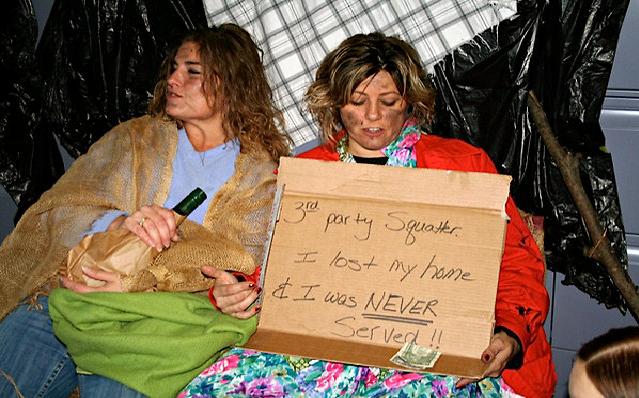
This one crossed the line.
As I always try to censor/warn of foul language in my posts, this one has gone too far to hold that back.
But, I guess, profane times deserve profane words…
Read the write up below and study the pictures. Look at them hard. This is what they think of you “deadbeats.”
This is an OUTRAGE!
Now, what are you going to do about it?
Prize for the person who identifies the girls in the pictures…
~

What the Costumes Reveal
On Friday, the law firm of Steven J. Baum threw a Halloween party. The firm, which is located near Buffalo, is what is commonly referred to as a “foreclosure mill” firm, meaning it represents banks and mortgage servicers as they attempt to foreclose on homeowners and evict them from their homes. Steven J. Baum is, in fact, the largest such firm in New York; it represents virtually all the giant mortgage lenders, including Citigroup, JPMorgan Chase, Bank of America and Wells Fargo.
he party is the firm’s big annual bash. Employees wear Halloween costumes to the office, where they party until around noon, and then return to work, still in costume. I can’t tell you how people dressed for this year’s party, but I can tell you about last year’s.
That’s because a former employee of Steven J. Baum recently sent me snapshots of last year’s party. In an e-mail, she said that she wanted me to see them because they showed an appalling lack of compassion toward the homeowners — invariably poor and down on their luck — that the Baum firm had brought foreclosure proceedings against.
When we spoke later, she added that the snapshots are an accurate representation of the firm’s mind-set. “There is this really cavalier attitude,” she said. “It doesn’t matter that people are going to lose their homes.” Nor does the firm try to help people get mortgage modifications; the pressure, always, is to foreclose. I told her I wanted to post the photos on The Times’s Web site so that readers could see them. She agreed, but asked to remain anonymous because she said she fears retaliation.
Let me describe a few of the photos. In one, two Baum employees are dressed like homeless people. One is holding a bottle of liquor. The other has a sign around her neck that reads: “3rd party squatter. I lost my home and I was never served.” My source said that “I was never served” is meant to mock “the typical excuse” of the homeowner trying to evade a foreclosure proceeding.
A second picture shows a coffin with a picture of a woman whose eyes have been cut out. A sign on the coffin reads: “Rest in Peace. Crazy Susie.” The reference is to Susan Chana Lask, a lawyer who had filed a class-action suit against Steven J. Baum — and had posted a YouTube video denouncing the firm’s foreclosure practices. “She was a thorn in their side,” said my source.
A third photograph shows a corner of Baum’s office decorated to look like a row of foreclosed homes. Another shows a sign that reads, “Baum Estates” — needless to say, it’s also full of foreclosed houses. Most of the other pictures show either mock homeless camps or mock foreclosure signs — or both. My source told me that not every Baum department used the party to make fun of the troubled homeowners they made their living suing. But some clearly did. The adjective she’d used when she sent them to me — “appalling” — struck me as exactly right.
These pictures are hardly the first piece of evidence that the Baum firm treats homeowners shabbily — or that it uses dubious legal practices to do so. It is under investigation by the New York attorney general, Eric Schneiderman. It recently agreed to pay $2 million to resolve an investigation by the Department of Justice into whether the firm had “filed misleading pleadings, affidavits, and mortgage assignments in the state and federal courts in New York.” (In the press release announcing the settlement, Baum acknowledged only that “it occasionally made inadvertent errors.”)
MFY Legal Services, which defends homeowners, and Harwood Feffer, a large class-action firm, have filed a class-action suit claiming that Steven J. Baum has consistently failed to file certain papers that are necessary to allow for a state-mandated settlement conference that can lead to a modification. Judge Arthur Schack of the State Supreme Court in Brooklyn once described Baum’s foreclosure filings as “operating in a parallel mortgage universe, unrelated to the real universe.” (My source told me that one Baum employee dressed up as Judge Schack at a previous Halloween party.)
I saw the firm operate up close when I wrote several columns about Lilla Roberts, a 73-year-old homeowner who had spent three years in foreclosure hell. Although she had a steady income and was a good candidate for a modification, the Baum firm treated her mercilessly.
When I called a press spokesman for Steven J. Baum to ask about the photographs, he sent me a statement a few hours later. “It has been suggested that some employees dress in … attire that mocks or attempts to belittle the plight of those who have lost their homes,” the statement read. “Nothing could be further from the truth.” It described this column as “another attempt by The New York Times to attack our firm and our work.”
I encourage you to look at the photographs with this column on the Web. Then judge for yourself the veracity of Steven J. Baum’s denial.
Article reproduced in full for educational purposes and to show the complete disregard for homeOWNERS in NY and across the country.
Source: NY Times
Thank you JOE NOCERA for covering this…
Rest of the pictures from their “party” can be viewed here…
And big thanks to the former employee of Steven J. Baum who had the courage to come forward with this information.
The world needs thousands more like you…
Why would anyone be surprised by the behavior shown by him and his staff? Remember who he works for!!!
Subscribe to:
Posts (Atom)